Line of Departure

Musings of a US Army reservist and China expat deployed to Iraq

Tuesday, February 8, 2011

Home Sweet Home

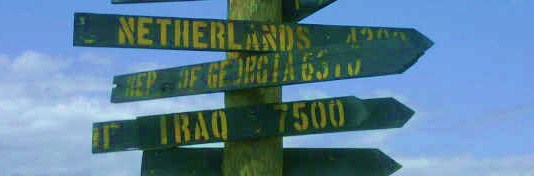
After 3 days of basically living out of airports looking for flights, Sarah and I made it back home.  I thought that this poster was pure irony.

Few lessons learned on dealing with a situation like this in the future that I thought I'd pass on:

  • Always monitor flight status -- Don't assume the carrier will notify you or rebook.  We never were, even after repeatedly giving our contact info.  They didn't protect us either, by putting us on another flight until we pushed the issue.
  • Have a contingency plan for alternate routing in case flights get cancelled.  Know the next flight going, alternate connections, seating availability
  • Often, it's really hard to get through on the phone, so use travel agent or hotel staff to help you get through.  EgyptAir staff often just ignore the phone.  Usually, the most effective way to get something done is to go directly to the airport or airline company sales office.
  • First try to rebook through United or whoever booked the original ticket.  If they did this, the local company often cannot make changes.  The good thing about working with the local company directly is that they are not bound to award travel only, but may put you in a regular seat if they feel like it.
  • Be polite but persistent and talk with different people and departments.  Don't give too much info and clearly state what you want – usually a rebooking, upgrade, compensation, or hotel accommodations. Often, we have been told no on the phone, then a different story at the airport or sales office.  Or, a counter agent will deny us seats, but a conversation escalated to the supervisor gets us there.  Document everyone's name and last name (and ideally a phone number) – don't be shy because if someone tells you something and you don't have their info documented, it's useless.  If possible, if someone promises that someone else will do something, rebook you, set you up with hotel, etc, have that person call over to their counterpart where you're going to make sure someone on the opposite end knows.  
  • If this doesn't work, tell them you would like to formally lodge a complaint.  Do this in writing, make a copy or take a photo, tell them you will follow this up with Star Alliance (or whatever mother network), and add their own name and why this was unsatisfactory.  Ask for a receipt or other formal acknowledgement.  Pushing it to this will often be enough.  A different person came out, all smiles, and said that they would put us up (despite everyone earlier telling us this could not happen) with full board.  He asked if this was satisfactory and if it would still be necessary to file the complaint.

Thursday, February 3, 2011

We're safe in Egypt

Thanks for the emails and SMSs of concern.  We've been on the open sea for most of the past week and since the Egyptian government cut internet and SMS service early on in the unrest, we weren't able to get word out.

Our weeklong liveaboard dive trip was interrupted as governments started pulling their citizens out of the country.  We had Polish, Dutch, and Greek divers onboard that had to leave early.  We decided that the safest place was on the open water, so decided to stay put and then take our chances.  Turned out to be a good idea, as the local port that we're in now, Hurghada, is actually quiet.  Unfortunately, we had planned to spend 4 days in Cairo, seeing the Giza Pyramids, the Sphinx, etc, but we just happened to pick the first time since 1953 that there's been civil unrest.

If you've been watching the news (we're only just catching up ourselves), you may know that Hosni Mubarak, the Egyptian president, who has held power for over 50 years, has agreed to step down in September.  Against him is a large group of the people who believe that the government is no longer for the people and want him ousted and a fresh change.  So far, the demonstrations have been peaceful and non-violent.  Mubarak, after mobilizing the Army, installed martial law and curfews as well as cutting internet and SMS.  Most countries, including the US, sided with the protesters and are urging Mubarak to let go.  

Depending on who you talk to, it was either a way for him to save face (instead of getting forced out right away) or a ploy by which he managed to stay in power.  Regardless, order has been restored, international flights are back on time, and the internet is back up.  There were up to a million people demonstrating on the streets (even in Hurghada) and it was by and large peaceful.  Tonight, when Sarah and I walked around Hurghada, we saw signs that there was still some concern – we saw military APCs, lots of police and security on corners, and groups of people holding banners and dancing through the street.  The most striking thing was that everyone we asked seemed to be pro-Mubarak and the atmosphere in town seemed to be pretty celebratory, although by many accounts, Mubarak had lost and the protesters had won concessions.  According to one shopkeeper we spoke with, in Hurghada, the government worked with the people and they gained from working through the government and with tourism, whereas in Cairo and some of the larger cities, there was a big gap between the haves and have-nots, and a perception (deserved or otherwise) that the government was corrupt and not helping the people.


Cairo still seems to be a hotspot -- apparently pro-Mubarak forces are now shooting, throwing rocks and bombs, and otherwise inciting direct violence.  Hopefully, the anti-Mubarak side can turn the other cheek and allow the media to report what's going on and pressure the government to let the Army intervene and restore order.


We'll be spending two days in Hurghada where it's peaceful and then transit through Cairo to Instanbul for a night before returning to Shanghai.

Saturday, January 22, 2011

Happy New Year's! Lady luck starting to smile?

Happy 2011 to everyone!  I'm late for the calendar new year, but in time for the Chinese (lunar) New Year!

This year, unlike the past 5 or 6 Xmas' I've been in China, I did not send an update out, nor cards.  The original plan was that I'd call everyone, but things got busy in the end, I snuck away to the Philippines, and well, you know how it is.  If the company every goes public, I'll buy you all ranch houses :)

Small business owners frequently say that they didn't take vacations for years in the early, lean times.  That probably means that they didn't have something like the Philippines nearby and they were really busy, which is a good thing.  Because: (a) my customers all went away for holidays in December or weren't thinking about testing, I didn't have much demand; (b) I don't run a retail store or other business that requires a regular working day presence; and (c) was able to get a roundtrip ticket to Manila for about 1000rmb (~$160), I escaped to go diving for about 5 days with a couple of buddies.  Sarah couldn't work, but went to HK for NY's, where I joined up with her to celebrate a friend's birthday.

As soon as the New Year's holidays were over, I expected things to get hot and heavy, as I caught up with unfinished conversations and sales leads from before the break.  Things were frankly, slower than I had anticipated, and honestly, I started questioning the business model and asking myself if we had fooled ourselves into thinking the market was ready.  Or was it the wrong marketing approach?  Wrong segment?  Wrong pricing?

For the past month or so, I've been thinking hard about the scalability of the business.  The sales process of an average residential air/water assessment is long and the execution and followup is as well:

1. Once I get contacted, I need to introduce the company.  I could probably use the website to introduce this more, but right now, I type out emails or have calls.  
2.  I then conduct an interview with the client to understand their background, health sensitivities, building structure, occupant activities, and any other concerns.  All of this background info is used to recommend the appropriate test panel and come up with potential hypotheses about any potential problems (ie. think there is mold, humidity is or a source of water is usually the primary cause, need to confirm that this exists or not)
3.  Send a project scope and cost quote
4.  Wait, wait, follow up, convince, wait some more until client finally agrees
5.  Schedule event & coordinate with relevant staff/partners
6.  Conduct site visit, sampling, and investigate the building, which may take 1-3 hours
7.  Wait about a week for lab results to come in.  Translate results and do analysis to complete detailed graphical assessment report for client
8.  Schedule followup debrief with customer and wait for them to pay me before debriefing
9.  Debrief with customer to review any problems found, impact, severity, root cause analysis, and recommended solutions -- usually a 60-90 min session, since I answer their questions and also discuss remediation
10. Follow up with them on solutions -- air filter sales, mold remediation, VOC elimination, plant sales, etc.

As you can see, this is a pretty painful process to make the small amount of money I am each time I do this.  I have to keep reminding myself that right now, this is worth doing because I learn from each client, gain good baseline data, create good word of mouth, can use the testing as an intro into the higher margin remediation work, and most of all, to get reference clients.  But, long-term, there has to be a way to make this more automated, easier, or to not have to do this all by myself.

In recent days, I've been looking at two things.  One is certification -- it's a set number of parameters and pricing, and only two packages, so it streamlines most of the pre-sales and sales.  Plus, by working with relocation companies, I can actually incent them to push my services because they get a markup themselves.

The other is getting into the upstream green or sustainable design space.  When a building is designed, the architects need to consider indoor environmental quality.  To get certified as a LEED project, there are specific rules and credits gained through testing that the air, sound, electricity, etc meets certain standards.  This means that I don't need to do the selling -- my services are needed to get LEED certified.  I only started exploring this maybe 3 weeks ago, attending a couple events, getting a couple introductions.  The book is still out on whether I can do this successfully, but I think if I stick to the boutique or smaller firms, there is not a lot of specialized knowledge about air quality, so I can help be the expert on LEED projects to do not only the testing, but also all of the paperwork as well as investigations if there are any problems.  Or, I can recommend ways on getting more points as related to indoor environmental quality.

Last Friday, I had two meetings.  Met with a Singaporean sustainable design firm that is quite impressive for their R&D know-how, deep knowledge of engineering science, and green building innovation.  I thought I would have little to offer them, but apparently, in China, they are almost brand-new and don't really have a lot of knowledge.  We were able to help each other, just through info transfer and through promises of joint intros to other people.  I do think that this is how business is done in China.  Then, I met up with a friend who has been helping me do website optimization, marketing, and other related work.  Originally, she was supposed to do a lot with Google Adwords and search engine marketing (SEM), but this went on ice when Google Adwords inexplicably decided to blacklist us (whole separate blog post).  But, we agreed that she would work until the end of January since she had other commitments and also we are really cash-strapped.  She did make a difference.  If nothing else, it's very good to be able to really toss around ideas and brainstorm with someone with a lot of initiative.  It will be lonely in Feb back on my own with my interns!

So, on Friday, aside from these two positive outcomes, a few other very happy things happened:
1.  I was given the green light to do a testing project with a very prominent, high end green architecture design firm
2.  Had the same design firm suggest that I would be able to fulfill an IAQ role with a large property development project
3.  A commercial company that Sarah introduced me to and has been a little bit of a black box, invited me to give a presentation to their finance director and facilities manager (this would be a great "reference" project)
4.  An acquaintance I met last week (for whom I had made an introduction to someone else) returned the favor by introducing me to yet another architect
5.  A request for a mold problem conversation turned into a formal meeting request
6.  One of our website visitors contacted us through the form and was in the ideal target segment (couple with a baby on the way)

So, just as I am about to leave for 2 weeks in a couple days, we suddenly have a lot of stuff going on.  I am thrilled of course, and very excited.  If things keep up like this, I will really have to start looking for reliable help.

How is everyone else's New Year's going?  Any resolutions you want to share since I didn't even think about making any?
Sunday, December 12, 2010

Project Startup Update Week 27 - The name of the game is SEO

Hey y'all - it's been awhile since I've blogged. Now that I am also blogging for the business website, chances to write are fewer and further in between. But, because this is not only a way to update some of you guys, but also a way to look back later and see how the business "grew up", I'm going to try to do at least one update a week.

Overall, up until the past couple of weeks, I've been still nailing down our operational model and figuring out processes -- the best way to follow up with sales leads, making sure our testing lab partner was using the right methods, tweaking the report analysis, creating invoice forms, etc. Most of that has been done, so now the emphasis is on getting the work out and creating awareness.

Nowadays, no business, no matter how small, can get by without a website. Especially for us, where credibility is key to customer acceptance, and in this market, where expatriates turn to the internet to find answers to their questions more than back at home, we had to create a very professional website, and one that would be current, relevant, popular, and most of all, highly ranked in searches. Enter SEO or search engine optimization. Up until two weeks ago, this was just a term. I had no idea what went into the mystical Google ranking algorithm. Then once the website launched and I started playing around with it, looking at what sort of traffic it was getting (or not getting), I figured I had to learn how to make the website more visible.

I sent out requests for help to a few local SEO service firms. These guys are experts at making your website show up higher in search results. After a solid week talking with them (having companies pitch to you is definitely the best way to quickly come up to speed), I have a little sense of the lay of the land.

How your website ranks is based on a number of things, a continuously changing algorithm that varies between different search engines. But in general, there are three things that affect this:

o Onsite factors – how well your website is built: the content, presence of a blog, the amount of keywords in the content, metadata built in, tags in the photos, etc.

o Off-site factors – the interaction of your site with the rest of the internet community: is it referenced by other sites and are those sites quality, is it indexed by the search engines so they can regularly “crawl” your site, is it present in directories, do you have guest blog content posted on other sites that reference your website.

o Search engine marketing (SEM) – you can simply and immediately improve your ranking by paying for advertising that increases your score


The results of running our site through a few free automated assessment tools (is a good one told us that the site was already built pretty well and didn't have a lot of room for easy technical improvement. That leaves content creation (mainly quality blog posts) and link-building as the main areas of work. But, the nature of SEO is that this takes a lot of time, so your rank comes up slowly even if you're doing all the right things. So, what I think we're going to do is to start by giving Google some money through buying some Adwords advertising and then using that to get us instant awareness and also find out what keywords are most effective. Then, we'll use that insight to inform our SEO efforts, and when we've organically built good links, content, and exposure on the internet, scale back inorganic SEM and use our own efforts to stay high on the rankings.


That's the idea anyways, and I think we have a decent shot at it because this space is pretty immature and there are not a lot of competitors who are seriously competing for page ranking in English for our kind of business. To illustrate, a week after the site launched, the first result of Googling "air testing shanghai" turned up a reference to our site from my friend's blog about air quality and our own site turned up at #6. This was without the site even being "indexed" by Google's automated web crawler or conscious efforts. So, by spending some time doing things right, we hopefully should be able to turn up on page one of search results for the main keywords we think people are searching for.


One cool thing happened today. I have some Google alerts set up to keep me up to date on any significant relevant news. In this morning's batch (keywords: China indoor air pollution), I found a blog post I wrote this weekend! Now, if I could only figure out how to get people to read those posts :) ....


Friday, November 12, 2010

Meet the newest member of our family

(Guys at my regular fruit and produce stand)


Nope, not one of "those" emails :)

After 5 years of taking taxis, subway, bus, mototaxis, biking, and just plain walking, I broke down and bought a scooter. What made up my mind was not having income, paying 80rmb (~$12) round-trip 3x a week to go to jiujitsu, and seeing the taxi tolls add up.

So, I did a little research and found out that you can get electric powered cool Vespa-styled scooters for about 3400rmb or about $500. You get a lot of bike for that. Mine will do 55km/hr, is fairly zippy (any faster and I could get into trouble), comfortable, and has a range of supposedly over 50km with each charge. I chose the smaller of two models because I could get longer range and also to get something that is a little lighter and more maneuverable. Best, it's almost totally silent and gives off no emissions. Shanghai's moving to more of these and I think it's great.

I put on about 25km today and have the following conclusions:

1. A lot of crazy drivers (car and bike) out on the road. People turning left from the middle lane, running red lights, stopped in the middle of the road, trying to defy laws of physics... and this is just from day 1. I will definitely have to be driving defensively.

2. It's cold...I need a quality jacket and gloves. I also probably should get a filtration mask -- sucking in everyone's emissions not cool. I'm going to start wearing my skiing helmet. Pretty sure this breaks some sort of motorcycling etiquette rule, but hey, a lot of drivers wear velvet horse jockey helmets, so it's not that bad!

3. When you are riding on the road, you really feel alive. I was reminded of a college and Army buddy's description of riding his bike from Harvard to MIT back when we were going to ROTC -- "It's like a live frogger game!" I will definitely get to know the city a whole lot better this way and looking forward to it.


[Update: after 50km]

Discovered that the battery gauge is unreliable and that effective range is about 40km. Discovered that bike is difficult to push.


Wednesday, November 10, 2010

Project Startup: Business Launched Today!

It took 5 months, but we finally had our official opening on Sunday's Wellness Works fair!

We set up the booth at about 10am -- most of the other 30 vendors had already finished setting up. It was tough to fit all the stuff needed for the booth in one cab so we took one of the Expo minivans. Fortunately, with 3 interns (plus a
boyfriend), and my wife there, we got set up in only about 15 min. I think the booth turned out fairly decently. Several people who came by the booth during the day mentioned that it looked well thought out and pretty professional :)

We had a good location -- central, with no one to our back and no one competing on either side for signage. Our booth had essentially a backdrop with our logo on a field of green, then two self-standing banners. On the 1.8m table itself, we had a display of 9 common household pollutants and a guessing game where people had to match the pollutant to the proper
name and health effects. Not probably the most fun game, but at least it was an easier way to break the ice than a straight sell. On the right hand side, we had a lucky draw where people could win gas-removing green plants (we brought a snake plant, a peace lily, and several aloe veras), vouchers for free lead testing, vouchers worth 250 or 500rmb, and one grand prize of a free complete home assessment worth 2000rmb (around $300). Also on the table, we had a fair promotion flyer, brochures in Chinese and English, frequently asked questions, and a sample of the completed report as well as a raw Chinese test company report.

There wasn't too much traffic in the morning. At first we found out that it wasn't that easy to get people to leave their personal information. This is probably that we just didn't ask for it. I had
initially planned to offer a lucky draw to people in exchange for them going through a quick little mini-assessment, but in the future, the better idea is probably to just get them to leave a business card and a sense of what they are interested in and then follow up later. I was one of four speakers to give a little talk ("Indoor Environmental Quality in China: The Good, the Bad, and the Ugly", but last minute the venue changed. I am not sure if that was the reason, but there was low turnout and only about 10 people (besides our staff) were there. Fortunately, there was pretty good interaction and people asked a lot of good questions and it generated 2 leads who later came to the booth. I also found that one of the best ways to quickly get people to understand the value we add is to show them the Chinese report, which is pretty bare and just has numbers, and then show them our report, which has an initial customer profiling and recommendations on what to test, then graphical test results based on both Chinese and international standards, and then analysis of problem sources and recommendations. People understood that much more than anything else we showed or explained. We really should show this more, but I would be careful to release it as an electronic source, because it could be copied.

Chinese Marketing 101: one big takeaway is that having young, overly formal-dressed, nervous looking Chinese staff hovering definitely drives away traffic. I watched expats literally look up at the booth then veer away. When Sarah, the blonde foreigner was there by herself, she got tons of traffic.

There were other competitors and potential
partners at the fair and I went over to meet some of them. There were air purifier representatives, a water purifier company, and a health retailer. Fortunately, still no sign of anyone else doing anything like what we are doing. It was interesting that several of the representatives from the other companies said that they had heard of us, and at least one rep said he wanted to meet up later to talk about working together. Really is a small community or else word spreads quickly.


At the end of the day, we had 7 potential customer leads, of which 3 are highly likely to convert into test projects. The most interesting one was a guy from sweden who is having a mold problem and was almost begging us for our help. Unfortunately, we don't know too much about mold outside of what I've learned in books. The good news is that there is almost no one else in China who does, so we can at least add some value. When I went into his apartment to take a look (he lived in the apartment complex that was hosting the fair), I felt like I was walking into a tropical jungle. Mold loves humidity, so it wasn't hard to be able to tell him that no matter what he does, it won't be successful until he can reduce the humidity.


Since Sunday, I have been able to meet with the retailers, who want to partner with us to certify their products and co-market, and will be meeting with an air purifier manufacturer tomorrow in order to work out some sort of referral relationship. The tough thing will be finding a balance between keeping our independent third-party position, while also offering downstream solutions and being able to make some money off of it.


I also did a lot of research on mold to be able to advise the customer with the mold problem. Followed up with a call today and we spoke for about an hour. He is very happy to have someone to talk to and is an "ideal" customer. Not only is he a good customer, but if we succeed with him, we can almost certainly get more business in that apartment complex and he will probably be a good advocate. I sent a proposal earlier tonight.

In the next few weeks, we will need to keep ironing out our processes, do good work to get a solid reputation, and then start expanding our marketing channels. Once we hit about 10 customers, I think it will be time to pull the trigger on full-time staff and some investment on test equipment.

The website is live too and that's a whole another animal -- adwords, blog maintenance, promotions, cross-marketing, search engine optimization... take a look and let me know what you think. Send me a message if you don't know the website address.


Tuesday, November 9, 2010

It's better to burn out than to fade away...


Last night I went to feed the fish and tossed a couple pellets in. Normally, these are snapped up right away by "Jaws", one of our four fish, the one I've been training to be a goldfish piranha by giving him bloody mosquitoes I've slapped. He didn't bite. I looked around and couldn't find him. We have a lot of rocks and junk in our rock tank, so it's easy to miss a fish. The longer I looked, the more the sinking feeling grew. I didn't want to, but I looked down on the ground around the tank.

See, back when we got Jaws, he had er, a little too much bounce in his step. The first night, he jumped out of the tank twice. Then he seemed to settle down or realized that might be hazardous to his health. Every now and then though, we still heard the "bloop" sound of him doing a Free Willy. I looked around and was relieved to find no dead goldfish. Then I thought maybe our cats might have snagged him. Or the ayi (cleaning lady). No luck. Finally, I pull back the curtains, and there in the shadows of the corner, I see a shadow that looks like... a fish.

I wimped out. I made Sarah look and left the room. "It's him" she goes. I never thought I'd feel bad about a fish (we've probably flushed a dozen down the toilet in the past 18 months). But this guy was a survivor. It was a real bummer. And as I watched the other fish, I wondered what they were thinking. "Hey where'd that other guy go?" or did they think he escaped to freedom, kind of like in "The Running Man"?

Rest in peace little dude

Sunday, October 24, 2010

Project Startup Update Week 19 - First customers!

They say that one of the major milestones in starting a business is the getting the first customer. I guess you could say we achieved that this week (inked the deal but haven't taken payment yet). Although I initially thought that the first bite would be from a friend who would be a test customer, it turned out to be another company in the health & wellness space. This company has been operating in Beijing for a few years now, has done well in selling retail health products and recently expanded to water and air. They decided to private label a water filtration device (healthily priced at over USD 1000). Yet, amazingly, they didn't have any R&D or test results to show how well the filtration device was doing! Normally, when you certify a water purification device through an agency like the NSF (National Sanitation Foundation), you undergo rigorous testing for device quality, safety, marketing truthfulness, and most importantly, contaimination reduction claims. They didn't get this certified (it's not a requirement in China, surprise surprise), and so had no idea whether this was working or not. They had gone to a water testing company in Beijing and were not satisfied. When I pressed for details, they said that it was because the company gave them no guidance on what they should test, didn't seem to do it scientifically, and just gave them a report with no interpretation.

This was great because their experience is exactly what we are trying to address. So, I spent probably close to 20 hours either meeting with the product manager, giving them free advice about Shanghai water, different filtration systems, researching the certification process, advising on contaminants and health effects, then suggesting different courses of action. The good side effect of this is that I learned a lot in the process. Probably put together the only 6 page statement of work for a $1200 project in existence, hehe. Although it took almost 2 months, this week they finally gave the go-ahead on a fairly comprehensive water comparison testing. If we do a good job (which I'm pretty confident we can deliver), not only do we establish credibility with our testing partner that we are doing real business of a healthy size (~$1200 project), we also are building a future business partnership with this client. They've talked about selling or pushing our testing services in their retail store and we're also interested in them being the fulfillment partner for some solutions.

Today, we also had our first residential customer! It was my childhood best friend who's lived in SH for 6 years. Recently married and expecting a baby AND having just moved into a new apartment, he and his wife, had two good reasons for getting tested. Of course, even if he wasn't interested, I would have leaned on him pretty hard, since I was his best man :) I ran them through a questionnaire about their building profile, health conditions, symptoms, etc. They didn't raise any alarm bells, so I recommended a middle of the road sort of package, focusing on air particulates, VOCs (volatile organic compounds), and lead identification, which are all particularly relevant to expectant mothers. The inspection went smoothly, except that it was a little long (2 hours long). His results will be pretty baseline.

Over the next couple of weeks, we are running a friends and family special, which lets us fine tune our procedures, reports, etc, get feedback, and hopefully spread word of mouth. In exchange, friends and family get tested at near cost. I just sent out the brochure in an email on Friday, and the weekend has been pretty quiet, but hopefully there will be some nibbles in the next few days.

Last mini-milestone: we officially completed our business incorporation in HK last week! Why incorporate in HK? Setting up a wholly-foreign owned enterprise (WFOE) in China is a long, iron-bound process, and making any changes to equity ownership, etc is painful. So, many companies set up a holding company in HK and then make changes through that. The HK process only took about 2 weeks (and $1600 or so). Pretty cool feeling to have the corporate stamps and embossing tool. I went a little crazy and ran around embossing everything in sight :)


Monday, September 13, 2010

China taxes are weird

I got a call from the agent who is helping me incorporate both the Chinese and the Hong Kong company.  The HK company has to be set up as a shell company to own the Chinese company because trying to make any changes to the Chinese company equity ownership is apparently a pain in the ass.  Also, there are some tax benefits.  In any case, I'm shelling out an extra $1700 to set up the HK company and an extra $1300 in fees every year for accounting and business license.  Not real happy about it, but it will leave me the option and I won't kick myself down the road if I need to get investors.

Anyhow the agent tells me that the business district she was going to register me in has arbitrarily changed its preferential tax policies.  Despite the tax law change in 2008 that unified taxes between Chinese and foreign companies, each local govt still has the ability to do little dope deals.  So, since their main objective is to attract investment, the govt of Fengxian had a sweetheart deal with my registration agent to refund 30% of my revenue tax (5% of revenues) and 15% of my business profit tax (25%) back to me.  Quite a good deal and I wasn't expecting it at all.

Unfortunately, Fengxian decided to reduce this by half.  So, now I'm asking the agent to go searching for greener pastures.  The agent obviously doesn't want to do it because they have a special deal with that district, but they should be shopping around for their customers.  It's really surprising that the agents don't bring this up as a selling point, because that could be VERY substantial over the long run depending on the size of the company.

But I guess it also makes sense because it's probably not something they want the central government to know is going on...